
Could a train run from Sterling Heights to Detroit?
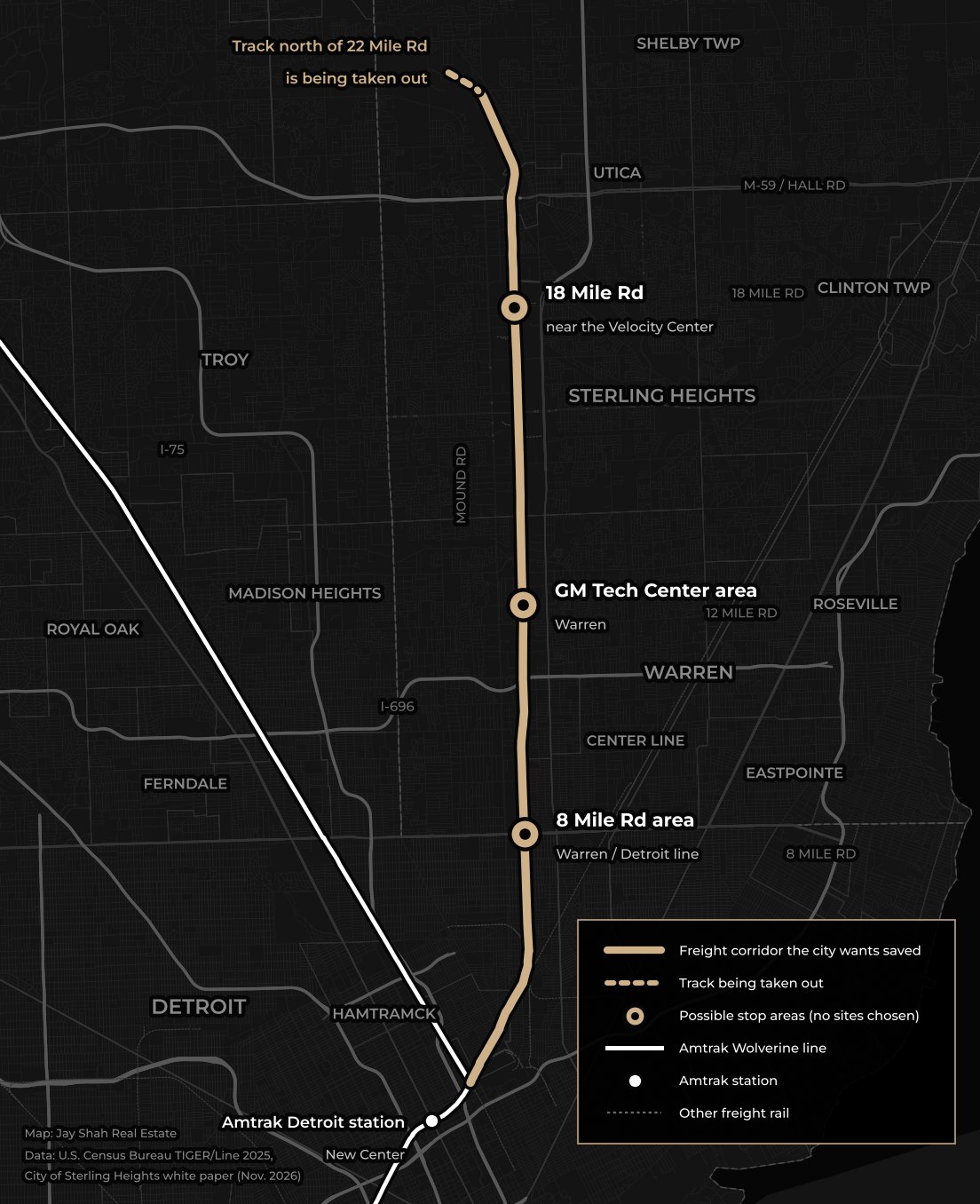
The freight corridor Sterling Heights wants to save, with the three possible stop areas named in the city's white paper. No sites have been chosen. Map by Jay Shah Real Estate from U.S. Census Bureau TIGER/Line 2025 rail and road data.
Sterling Heights is looking at an idea Metro Detroit has argued about for decades: a passenger train between the suburbs and downtown Detroit. On Nov. 4, city staff presented a white paper to the city council about saving an existing freight rail line through Sterling Heights and Warren so it could carry passengers someday. Nothing has been approved. Here's what the city is proposing, where the trains could go, why the city says it can't wait, and how the region's last big transit vote went.
- Who
- City of Sterling Heights. The city council asked city administration for a white paper on it.
- What
- Keep the Conrail freight corridor through Sterling Heights and Warren intact for possible passenger trains
- Length
- About 26 miles, as the city describes it
- Possible stops
- Near the Velocity Center on 18 Mile Road, near the GM Technical Center in Warren, and around 8 Mile Road
- Service idea
- Roughly one train an hour
- Could connect to
- Downtown Detroit, Detroit Metro Airport, and the Amtrak network
- Rough cost
- "Hundreds of millions of dollars," by early city estimates, C&G Newspapers reported
- Next step
- Funding for a feasibility study, which the city hopes to line up in 6 to 12 months
- Status
- "No project, station locations, funding commitments or construction schedule have been approved," the city says.
What Sterling Heights is proposing
The Sterling Heights City Council directed city administration to prepare a white paper on promoting passenger rail, The Detroit News reported. Staff presented it to council on Nov. 4, and the city put out a news release the next day. The paper looks at whether the Conrail freight corridor that runs through Sterling Heights and Warren could someday carry passengers to downtown Detroit.
Sterling Heights City Hall. Photo: Ajay Suresh, CC BY 4.0, via Wikimedia Commons.
For now the city isn't asking to build a train. It's asking to keep the rail line in one piece while the region decides whether a train makes sense. City Manager Mark Vanderpool put it this way in the city's release, as reported by WDIV:
"We are beginning a regional conversation about whether this existing asset could support future passenger rail service."Mark Vanderpool, Sterling Heights city manager
He told The Detroit News that "public transit, including passenger rail, is a major economic driver," and told WXYZ he sees it as "the next phase to prosperity. Not only for our city, but for the region." To CBS Detroit, he summed up the city's position in one line: "We have the backbone right here in our city."
Who would ride it
A city management intern told CBS Detroit the train could help Macomb County residents who head to Detroit for entertainment: they could park in the suburbs, ride in, and not have to drive after drinking at a game.
Residents who talked to local TV stations liked the idea. "Oh man, the commute would be wonderful," Sterling Heights resident Nekita Lovelace told CBS Detroit. "I think a lot of people would use it," Tahmid Ahad told WXYZ. Warren resident David Rosseel told WXYZ he'd use it for Lions games so he wouldn't have to drive or park, adding, "Having no public transit anywhere in the area has always been a problem with Detroit." Nate Hatton, an Amtrak conductor who spoke with CBS Detroit, said residents could "board a train in their own community" and connect to Detroit, the airport or Chicago.
Watch the TV reports with the full interviews: WXYZ 7 Action News · CBS Detroit · WDIV Local 4
What people have said since
In the days after the presentation, the idea drew a supportive statement from the Regional Transit Authority of Southeast Michigan, which owns and runs the QLine. "When a community steps up for better transit, it helps build a stronger, more connected region," RTA executive director Ben Stupka said, according to The Voice News. "Working together on ideas like this is important, and the RTA is always happy to join those conversations."
"The infrastructure is there. We're not necessarily blazing a new trail," Vanderpool told WDIV in a follow-up story. "We're really serious about this. We think it's a viable idea."
On the Sterling Heights City Council, member Michael Radtke called passenger rail a "tremendous amenity" but was blunt about the timeline, C&G Newspapers reported. He said the cost estimates are "very high" and that it would likely be a "decade-long process." "I don't think we're going to get there quickly," he said. Macomb County Executive Mark Hackel declined to comment to The Voice News.
The Detroit transit advocacy group Transportation Riders United called saving the corridor the paper's main point, noting that "once rail is removed along these corridors, it rarely comes back." The group wants another regional transit measure on the ballot in 2028 or 2030 to pay for projects like this one.
The rail line and the possible stops
The corridor is an existing Conrail freight line. On the map above, it runs north from near Milwaukee Junction, just east of New Center, through Hamtramck, then between Mound Road and Van Dyke through Warren and Sterling Heights, and on toward Utica and Shelby Township. It's still a working freight line.
It has carried more than freight before. Utica was a station stop on the Michigan Central's Detroit to Bay City branch, according to the Michigan railroad history site michiganrailroads.com, which notes the old Utica depot burned in 1982 and that the town is still served by Conrail.
The white paper names three possible stop areas. These are areas to study, not chosen sites:
- 18 Mile Road, Sterling HeightsAt or near the Velocity Center, the city-owned business incubator at 6633 18 Mile Road between Van Dyke and Mound, about a tenth of a mile from the tracks, per The Detroit News, Daily Detroit and C&G Newspapers. WDIV and The Voice News described the Sterling Heights stop area as near Hall Road (M-59).
- GM Technical Center area, WarrenThe line runs by GM's Technical Center campus between 12 and 13 Mile.
- 8 Mile Road areaWhere the line crosses 8 Mile at the Warren and Detroit border.
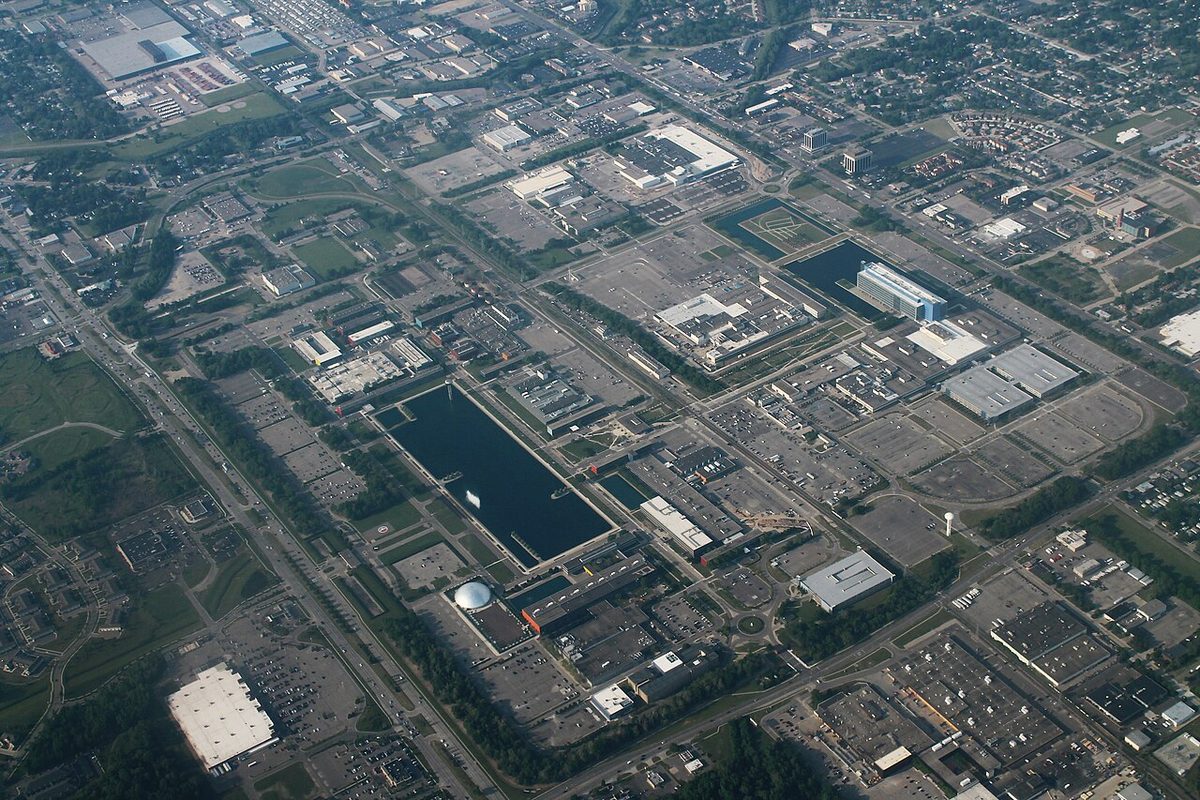
The GM Technical Center in Warren from the air, 2016. One of the possible stop areas is near the campus. Photo: formulanone, CC BY-SA 2.0, via Wikimedia Commons.
The white paper sketches out service about once an hour through the main part of the day, according to WDIV and Daily Detroit.
Where it could connect
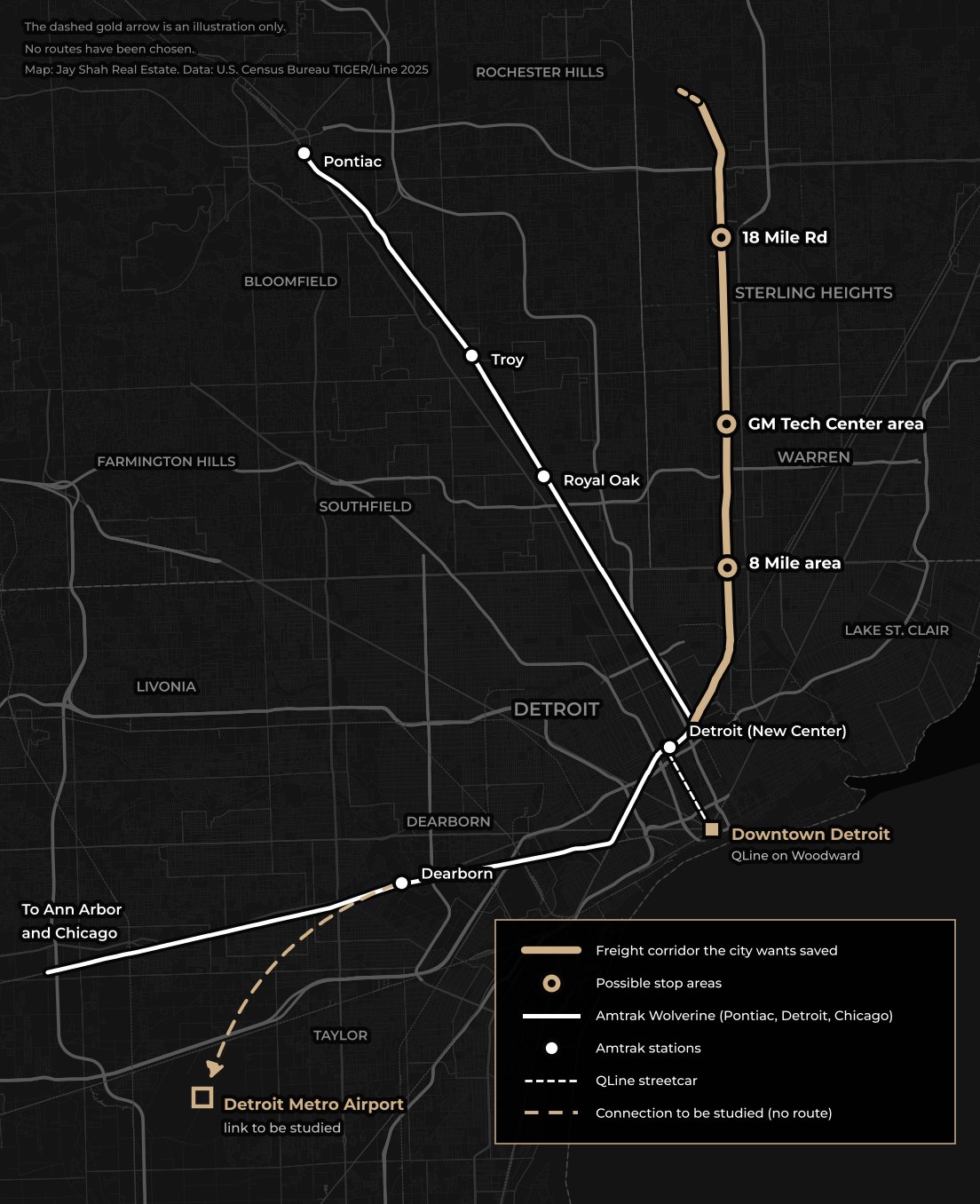
How the corridor lines up with rail service that already exists. The dashed gold arrow only illustrates the idea of an airport link; no routes have been drawn. Map by Jay Shah Real Estate from U.S. Census Bureau TIGER/Line 2025 data.
The south end of the corridor meets the line Amtrak's Wolverine trains use near New Center. Amtrak's Detroit station is on Baltimore Street in New Center, and the QLine streetcar runs from New Center down Woodward to downtown. Amtrak stops in Pontiac, Troy, Royal Oak, Detroit and Dearborn on its way to Ann Arbor and Chicago.
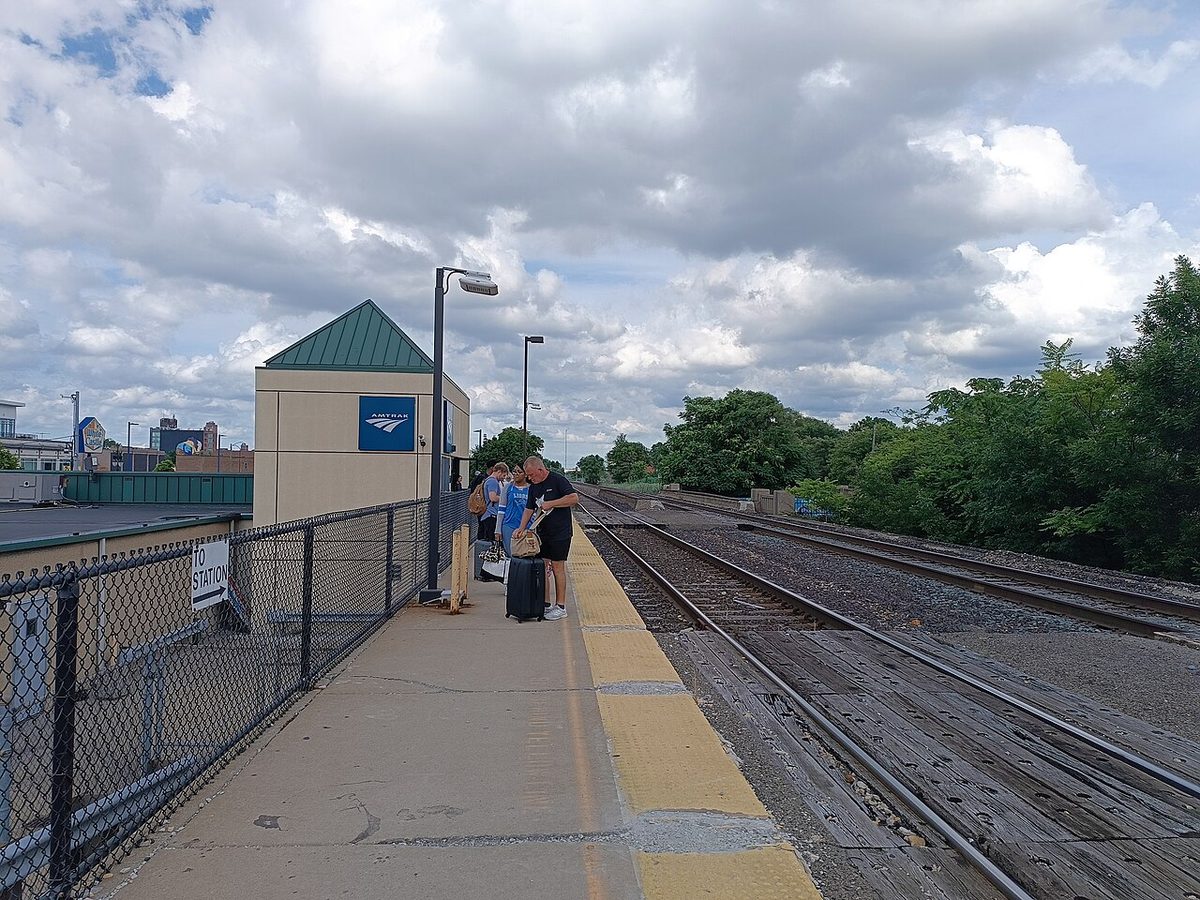
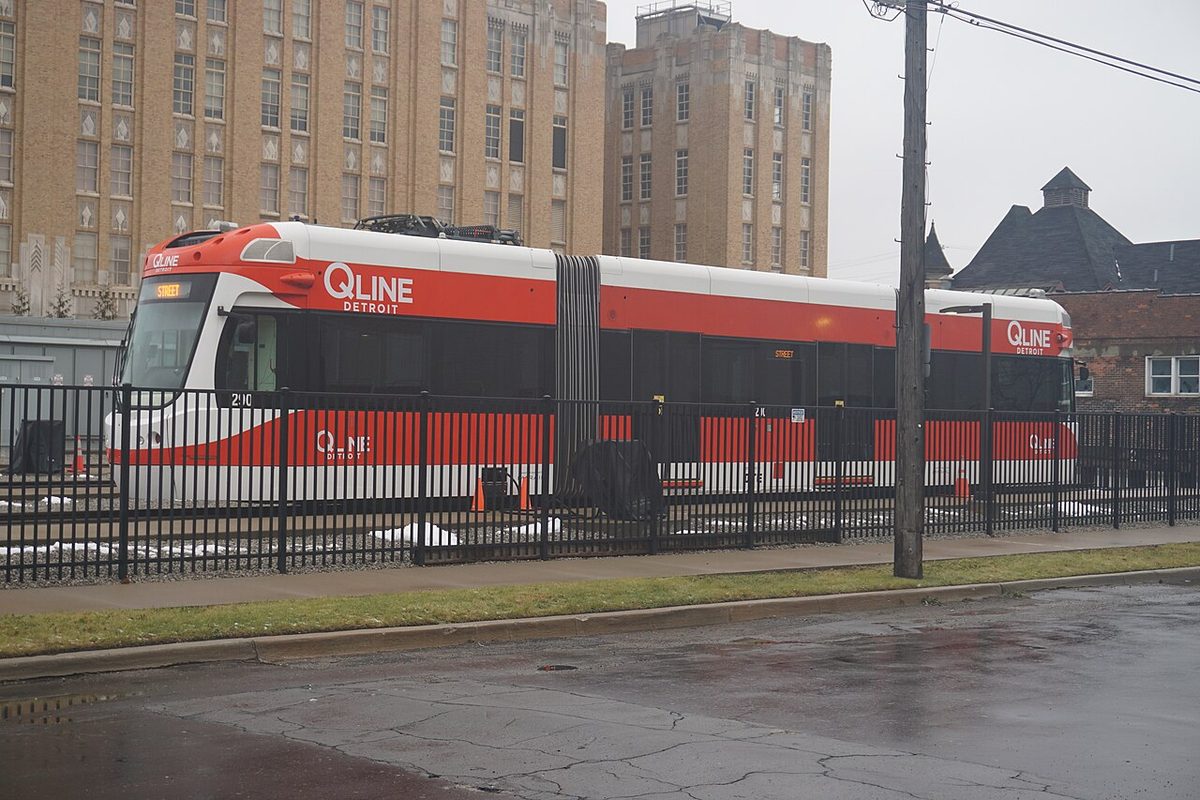
That's why the city keeps mentioning Chicago. WDIV reported the goal is practical links to the rail network, especially for trips to Chicago and other cities Amtrak already serves. The white paper also lists Detroit Metro Airport as a connection to study, and WXYZ reported the concept could also include a route to the airport. There is no rail line to the airport today.
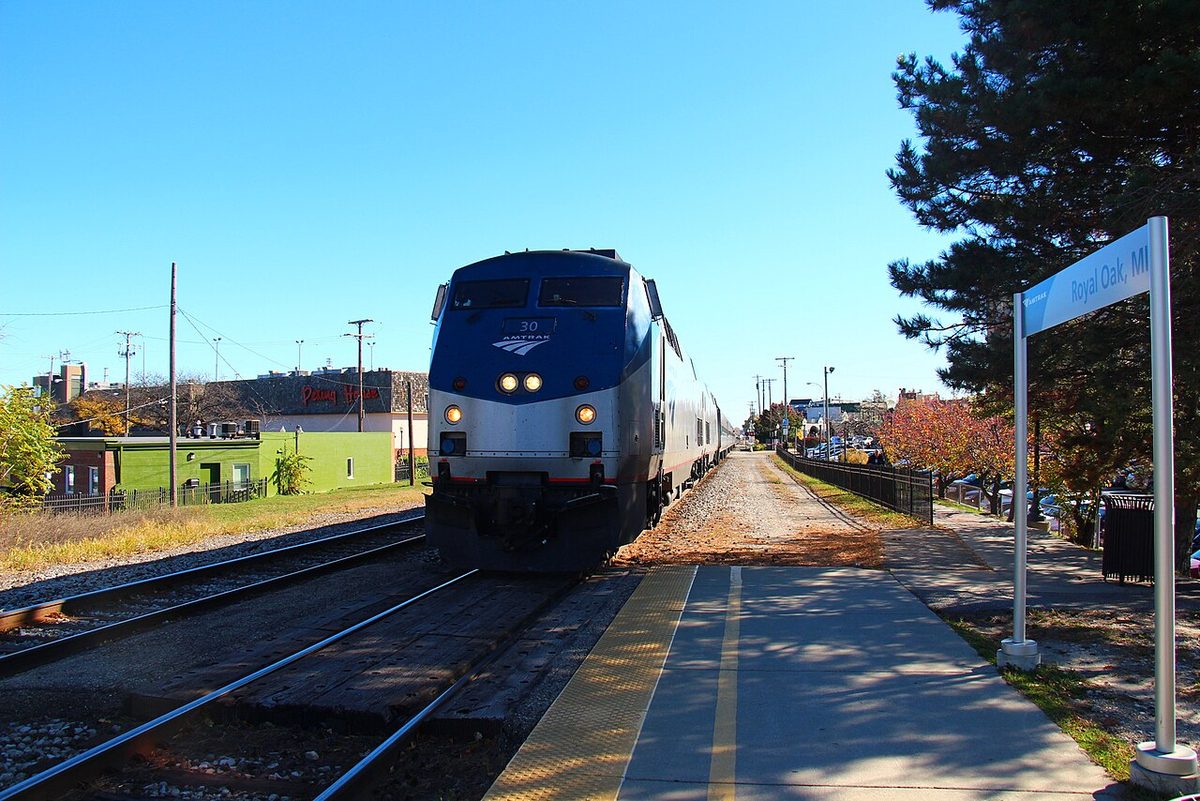
Amtrak's Wolverine at the Royal Oak station, 2014. Photo: Jeff Dunn, CC BY 2.0, via Wikimedia Commons.
Amtrak trains or light rail?
That's still open. The Detroit News reported the study would look at whether the service should be Amtrak passenger rail or light rail. Any plan would also need Warren, Detroit, Macomb County and the state on board.
Why the city says it can't wait
Pieces of the line are already disappearing. Conrail has started removing sections north of 22 Mile Road, WDIV reported, track that Transportation Riders United describes as "unused and expensive to maintain." Vanderpool told The Detroit News he thinks Conrail could sell off more of it. The white paper warns the region could lose "a rare north-south rail corridor that would be very difficult to rebuild later," and that "if it is allowed to keep shrinking, Macomb County may lose one of its few realistic opportunities."
"If the corridor is preserved, the region keeps its options."City of Sterling Heights white paper, as quoted by WDIV
"This could be an opportunity whose window will start closing over the ensuing years," Vanderpool told WXYZ. He told The Detroit News the city wants to be "proactive" and to "protect this vitally important infrastructure for the future."
What happens next
The city is starting talks with Warren, Detroit, Macomb County, Conrail, the Michigan Department of Transportation, the Regional Transit Authority of Southeast Michigan, SMART, Amtrak and others to see whether there's regional support for a professional feasibility study, according to WDIV.
That study would look at passenger demand, track conditions, how passenger trains would share the line with freight, station locations, safety, costs and funding options. The city hopes to have funding for it within 6 to 12 months, CBS Detroit and WXYZ reported. Public input would be part of the review, according to C&G Newspapers.
A study is only the start. WDIV laid out what else would have to happen: Conrail would have to agree to share the line, the Michigan Department of Transportation would have to get involved, state lawmakers would have to support it, Amtrak would need to run the service, and money would have to be found for stations and equipment. City officials' rough early estimate for the whole plan is in the hundreds of millions of dollars, and Radtke expects a decade-long process. Building a brand-new corridor instead would cost far more and take far longer, WDIV noted.
Metro Detroit's transit history at the ballot box
If this sounds familiar, it should. Metro Detroit has had passenger trains to the suburbs before, came close to a regional transit system in 2016, and has watched more than one plan fall apart over who pays.
The commuter trains we used to have
From Aug. 1, 1931, the Grand Trunk Western ran commuter trains between Detroit and Pontiac, with stops in Ferndale, Royal Oak, Birmingham and Bloomfield Hills. The Southeastern Michigan Transportation Authority, SEMTA, began covering part of the losses in 1974 and took full responsibility for them in 1978. Later timetables listed the Renaissance Center as the Detroit end of the line. Daily ridership was 3,000 in 1981. The last train ran on Oct. 17, 1983. SEMTA was facing a $16 million budget shortfall and aging equipment, and it estimated the trains cost about $1 million a year to run.
The federal money that went away
In the 1970s, President Gerald Ford pledged $600 million for transit to cities that could build "people movers," WDET reported. The plan for Detroit was supposed to link the city to the suburbs with rail lines above and below ground. City, state and suburban leaders couldn't agree on regional transit, the money went away, and Detroit ended up with what WDET called a "closed 3-mile loop carrying passengers around downtown": the People Mover.
2016: the vote that came up short
In November 2016, voters in Wayne, Oakland, Macomb and Washtenaw counties were asked to approve a 1.2-mill property tax for 20 years to fund a $4.6 billion regional transit plan. ClickOnDetroit put the cost at about $95 a year for the average home. For Macomb County, the plan included bus rapid transit with dedicated lanes on Gratiot from M-59 to downtown Detroit, an airport express from Hayes and Hall Road, an express route along M-59 from Mount Clemens to Pontiac and Auburn Hills, and a bus line from 23 Mile down Van Dyke into Detroit. Region-wide it also included trains between Ann Arbor and Detroit.
It failed 50.5% to 49.5%, a margin of about 18,000 votes out of 1.8 million.
Gold is the yes share. The white tick marks 50%.
| County | Yes | No | Result | President, same ballot |
|---|---|---|---|---|
| Washtenaw | 94,326 | 73,654 | Passed | Clinton +41 |
| Wayne | 360,883 | 323,720 | Passed | Clinton +37 |
| Oakland | 292,462 | 293,599 | Failed by 1,137 | Clinton +8 |
| Macomb | 148,206 | 222,883 | Failed | Trump +11.5 |
| Four counties | 895,877 | 913,856 | Failed |
The transit vote followed the presidential race on the same ballot. Hillary Clinton won Washtenaw by 41 points and Wayne by 37, and both counties passed the transit tax. Clinton won Oakland by 8 points, and the transit tax failed there by 1,137 votes. Donald Trump won Macomb by 11.5 points, and Macomb voted the transit tax down by 20. The opposition did cross party lines: Macomb County Executive Mark Hackel, a Democrat, was against the plan too.
Why did it lose? Megan Owens of Transportation Riders United told Michigan Public that supporters knew it would be a hard sell in a region where about nine in ten people don't use transit, "when people are already feeling heavily taxed," and that the plan's benefits weren't enough to overcome "that anti-tax mood." Before the vote, Macomb County Executive Mark Hackel and Oakland County Executive L. Brooks Patterson were concerned about their counties' taxes mostly helping other counties, Michigan Public reported, and a group led by Leon Drolet put out a release saying the plan had severe flaws. Ned Staebler, one of Washtenaw County's two members on the RTA board, told Model D in 2019 that the lack of proposed improvements Downriver, in northern Oakland County and in parts of Macomb "dampened some enthusiasm."
2018: the plan that never reached voters
In 2018 a bigger plan, called Connect Southeast Michigan, asked for a 1.5-mill tax over 20 years, expected to raise $5.4 billion. Detroit Mayor Mike Duggan and Wayne County Executive Warren Evans backed it. It needed a unanimous vote on the RTA's funding allocation committee to get on the ballot, and Oakland and Macomb voted it down in July 2018. Then Oakland County Executive L. Brooks Patterson told The Bond Buyer, "The RTA's biggest obstacle was that they got greedy."
Since then
- March 2020The RTA launched the D2A2 express bus between Ann Arbor and Detroit.
- November 2022Oakland County voters approved their first countywide transit tax, 0.95 mill for 10 years, 332,410 to 248,240. Macomb renewed its SMART tax with 66% yes.
- March 2024The Detroit Air Xpress bus to Detroit Metro Airport began service.
- September 2024The RTA took over ownership and operation of the QLine streetcar.
- Nov. 3, 2026Macomb County voters renewed the SMART bus millage, 0.94 mill for five years, with about 65% yes, according to WWJ.
- Nov. 4, 2026Sterling Heights staff presented the passenger rail white paper to the city council.
A note on the Nov. 3 Macomb vote: it renewed the bus service the county already has. It was not a vote on a new regional plan or on rail, so it doesn't tell us how a rail tax would do. But it's a long way from the 60% no Macomb gave the 2016 plan.
Why public transit is good for people
At its simplest, transit gives people another way to get to work, a game, a night out or the airport without a car, and without the cost of driving and parking. The research points to benefits well beyond the ride itself:
The home value figure comes from a 2013 study by the American Public Transportation Association and the National Association of Realtors, "The New Real Estate Mantra: Location near Public Transportation," which looked at the Boston, Chicago, Minneapolis-St. Paul, Phoenix and San Francisco regions. In the Chicago region, the closest of those to Metro Detroit, homes near frequent transit did 30% better. "When homes are located near public transportation, they are among the most valuable and desirable in the area," APTA's president at the time, Michael Melaniphy, said. The jobs figure is from the same report, and the safety figure is from APTA, which also says transit, including commuter rail, accounted for 1.4% of deaths on the nation's highway and transit systems in 2024.
Keep in mind that APTA is the transit industry's trade group, and the study measured homes near frequent service in big transit systems. A train once an hour in Macomb County would be a different thing, and nobody can say yet what it would do here.
And there's the point a city staffer made to CBS Detroit: a train to a game downtown means people can leave the car in the suburbs and not drive after drinking.
The case against
Every transit plan in this region has run into the same questions, and this one will too:
Who pays. The 2016 plan lost on a property tax, and the 2018 plan died over how much it would raise and from whom. The SEMTA trains ended in 1983 in the middle of a $16 million budget shortfall. Early city estimates put this plan in the hundreds of millions of dollars, and a council member who called rail a "tremendous amenity" also called those numbers "very high." Where that money comes from is still an open question.
Who rides. Transit advocates themselves pointed out in 2016 that about 90% of people in the region don't use transit. Hourly trains have to be useful enough to change how people get around.
Sharing the tracks. The line is an active freight corridor. How passenger trains would share it with freight is one of the things the study has to answer.
A feasibility study is where those questions get real answers. Until then, this is an idea, not a project.
What it means for homeowners
It's too early to say. No stations have been picked, nothing is funded, and any service is years away. For context, here's where the two cities on the line stand over the 12 months ending October 2026:
- Sterling Heights
- $315,000 median sale price, up 1.6% from a year earlier
- Warren
- $215,000 median sale price, up 6.7% from a year earlier
Source: GreaterMLS via FlexMLS, all Michigan MLS data sources. Median closed sale price, residential, 12 months ending Oct. 31, 2026 vs. the 12 months ending Oct. 31, 2025. Look up any city on the Market Data page.
Sources
- The Detroit News, "Sterling Heights explores concept of passenger rail service to Detroit," Nov. 6, 2026
- WDIV Local 4, "Sterling Heights exploring options for launching passenger rail service to Detroit," Nov. 6, 2026
- WXYZ, "Sterling Heights explores passenger rail connection to downtown Detroit and beyond," Nov. 5, 2026
- WDIV Local 4, "Could Sterling Heights really get a passenger rail line? Here's what it would take," Nov. 9, 2026
- Transportation Riders United, "What's Up with the Sterling Heights Rail Proposal?" Nov. 9, 2026
- Mass Transit, from The Voice News, "Regional transit agency supports Sterling Heights' proposal for passenger-rail study," Nov. 12, 2026
- C&G Newspapers, "Sterling Heights exploring passenger train service," Nov. 13, 2026
- CBS Detroit, "Sterling Heights considering possible rail service line to downtown Detroit," Nov. 6, 2026
- Daily Detroit, "Passenger rail in Sterling Heights? Plus, a coffee shop move and Tosca in Detroit," Nov. 5, 2026
- City of Sterling Heights, passenger rail white paper, presented to city council Nov. 4, 2026
- michiganrailroads.com, "Station: Utica, MI"
- Wikipedia, "SEMTA Commuter Rail"
- WDET, "CuriosiD: Why doesn't Detroit have a subway or elevated rail?" Aug. 22, 2016
- ClickOnDetroit, "Metro Detroit regional transit plan: Here's how the 4 counties voted in 2016," Mar. 16, 2018
- ClickOnDetroit, "Breaking down RTA's proposal for Macomb County," May 31, 2016
- Wikipedia, "2016 United States presidential election in Michigan" (results by county)
- Michigan Public, "Hackel on regional transit efforts: Macomb voters 'don't want this thing'," Mar. 20, 2018
- Metro Magazine, "Ballot measure defeat sends Mich. RTA officials back to drawing board," Nov. 10, 2016
- Michigan Public, "No transit upgrades for Metro Detroit as regional millage fails," Nov. 9, 2016
- Michigan Public, "Southeast Michigan residents, here's what to know about your transportation ballot proposal," Oct. 22, 2016
- Model D, "From a 2020 ballot measure to smaller projects, what's next for regional transit?" Oct. 15, 2019
- ClickOnDetroit, "Regional Transit Authority plan for Southeast Michigan won't make November ballot," July 19, 2018
- The Bond Buyer, "Southeast Michigan transit tax plan won't make the ballot," July 20, 2018
- Wikipedia, "Regional Transit Authority of Southeast Michigan"
- Yahoo News, "Oakland County all in on transit as millage passes; Macomb, Wayne voters also show support," Nov. 10, 2022
- WWJ, "Proposals on the ballot in Metro Detroit: What passed, what failed," Nov. 4, 2026
- Transportation Riders United, "Macomb County voters overwhelmingly back SMART tax renewal," Nov. 5, 2026
- Metro Magazine, "Report: Home values performed 42% better near public transportation," Mar. 21, 2013
- APTA, "Public Transit Safety" talking points, Oct. 22, 2025
- Maps: U.S. Census Bureau TIGER/Line 2025 (rail lines, roads) and 2024 cartographic boundary files
- Photos: Wikimedia Commons contributors Ajay Suresh, formulanone, Kyah117, Michael Barera and Jeff Dunn, under the Creative Commons licenses named in each caption
Thinking about buying or selling?
Whether you're in Sterling Heights, Warren, Detroit or anywhere in Metro Detroit, call or text Jay at (248) 982-4826.