
Detroit property taxes · Updated October 2026

What Is the NEZ Tax in Detroit?

Neighborhood Enterprise Zones explained: what they are, why Detroit has them, where every current zone sits, and how to work out what you would actually pay.

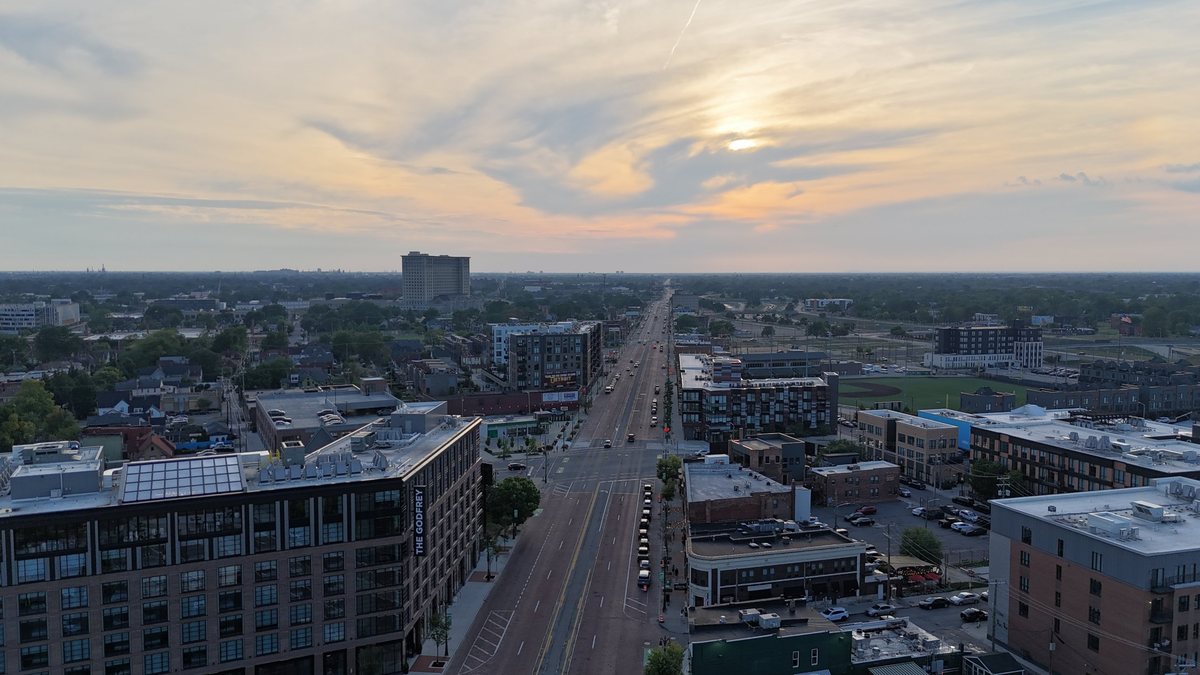
Corktown, Detroit at sunset with Michigan Central in the distance, from a drone
Corktown from above. Both a Homestead zone and several New and Rehab districts sit inside this frame. Drone photo by Jay Shah.
The short answer

An NEZ is a tax break on the house, not the land

A Neighborhood Enterprise Zone is a Michigan property tax abatement, created by Public Act 147 of 1992, for homes inside areas that a city council designates. If you hold an NEZ certificate, the building you live in is taxed under a different formula for a set term, up to 15 years. The land under it is still taxed at Detroit's full rate.

There are three kinds. NEZ Homestead cuts the city and county operating mills on an existing owner-occupied house in half. NEZ New taxes a newly built home at a flat statewide rate, 17.55 mills on the building for an owner-occupant in 2026, instead of Detroit's 64.18. NEZ Rehab freezes the building's taxable value at its pre-renovation number so the improvements are not taxed during the certificate.

Detroit has 158 Homestead zones covering roughly 13,000 acres, plus 119 active New and Rehab districts. The map, the formulas, and a calculator are below.

Part one

What an NEZ actually is

Start with why Detroit needs this at all. A Michigan homeowner's typical total tax rate is about 35 mills. Detroit's is 64.18 mills for an owner-occupied home and 82.18 for a rental or second home. A mill is one dollar of tax for every thousand dollars of taxable value, so on the same taxable value a Detroit owner pays close to double what the average Michigan owner pays. The state created Neighborhood Enterprise Zones to blunt that in cities that needed people to buy, build and fix up houses.

Here is the mechanical part, and it is the part most people get wrong. Every parcel is really two things: the land and the structure on it. An NEZ certificate takes the structure off the regular tax roll and puts it on a separate "NEZ roll" with its own formula. The land stays exactly where it was, taxed at the full rate. You get two tax bills in July and two in December, one for each piece.

ONE PARCEL LAND BILL 1 · THE HOUSE NEZ FORMULA Reduced for the life of the certificate BILL 2 · THE LAND FULL RATE Never abated. Taxed like any other lot.
The abatement applies to the structure only. Land is taxed at Detroit's full rate no matter which certificate you hold.

Three things follow from that, and they drive everything else on this page.

  • It is not based on square footage. People hear "you only pay on the building" and assume the tax is figured by building size versus lot size. It is not. It is figured on taxable value, the dollar figure the Detroit Assessor assigns to the land and to the structure separately. A small house on a big lot and a big house on a small lot are treated the same way: whatever the assessor says the structure is worth gets the NEZ formula, and whatever the land is worth does not.
  • A zone and a certificate are two different things. City Council draws the zones. Being inside one makes you eligible. It does nothing until an owner applies and a certificate is issued for that specific parcel.
  • It is temporary and it steps back up at the end. Certificates run for a term City Council sets, up to 15 years. Over the final three years the savings shrink in steps before the house returns to the regular roll.
Part two

Why it exists, and how it got to 2026

In the early 1990s almost nobody was building houses in Detroit, and a lot of the existing stock needed work. Lansing's answer was a targeted abatement: lower the tax on new and rehabilitated homes inside designated zones so the math on building or fixing one would pencil. The law has been amended several times since, and each change explains a feature you still see today.

  1. 1992

    Public Act 147 of 1992, the Neighborhood Enterprise Zone Act, takes effect July 16. Introduced as Senate Bill 662 by Senator Jon Cisky, it lets eligible cities designate zones where new construction is taxed at half the statewide average rate and rehabilitated housing is taxed on its pre-improvement value. Certificates run 12 years. Detroit's first districts, including Victoria Park, Virginia Park, Jefferson-Chalmers and Harbortown, date to this year, with Corktown following in 1994.

  2. 2006

    Public Act 340 of 2005 takes effect January 3. It creates the Homestead category for existing owner-occupied houses, stretches certificate terms to a range of 6 to 15 years, and adds the final-three-year step-up that every certificate now follows.

  3. 2006 to 2007

    Detroit City Council designates its first wave of Homestead zones in two phases, 52 areas in all, from modest high-ownership blocks like Morningside and Grandmont to historic districts like Boston-Edison, Palmer Woods, Indian Village and Woodbridge.

  4. 2008

    Public Acts 204 and 228 let a zone in a "qualified downtown revitalization district" be smaller than the usual ten platted parcels. This is why so many downtown and Midtown apartment buildings sit in their own tiny NEZ districts.

  5. 2016

    Council Member Scott Benson asks Council to revisit the Homestead map, which had not changed in nearly a decade while the city's neighborhoods had.

  6. 2021

    On June 15, City Council adopts redrawn and newly added Homestead zones. The current map, 158 zones covering about 13,000 acres, close to the 15 percent of the city the law allows, dates from this vote. Eligible owners in the new areas received application letters from the Assessor.

  7. 2023

    Public Act 238 of 2022 takes effect March 28. Any Michigan city, village or township can now create NEZs, not only distressed communities, and a "workforce housing" version appears for suburbs. The same year Mayor Duggan proposes a Land Value Tax plan that would stop new NEZ designations and replace them with a citywide cut; it needs state legislation that had not passed as of early 2026.

  8. 2025 to 2026

    Council reviews Homestead boundary expansions, most recently the Bagley neighborhood. The state sets the 2026 New-facility rates at 17.550 mills for an owner-occupied home and 27.070 for everything else.

Part three

The three kinds of NEZ

People say "NEZ" like it is one thing. The letter after it matters more than the word. Here is each one, who it is for, and what it does to the bill. The mill rates below are Detroit's 2025 figures and the state's 2026 New-facility rates.

NEZ-H

Homestead

Half off city and county operating mills12.7018 of Detroit's 64.1844 mills come off the house. About 20 percent off the building's tax.
Who
You own and live in an existing house inside a Homestead zone, bought after December 31, 1996, with your Principal Residence Exemption and Property Transfer Affidavit on file.
Catch
You commit to at least $500 of repairs or improvements early in the term (Detroit's application says two years, state guidance says three). Owner-occupied only. The day it stops being your primary home the certificate is automatically revoked, so there is no investor version.
Term
Detroit issues these for 15 years. You can reapply when it ends.
Where
The 158 gold areas on the map below.
NEZ-N

New

17.55 mills on the houseHalf the statewide average rate instead of Detroit's. Roughly a 73 percent cut on the building. 27.07 mills if it is not your primary residence.
Who
Newly built homes and condos anywhere inside a New/Rehab district, as long as an owner lives in the unit. That covers new builds across the city, not just downtown: Corktown, Midtown, Brush Park, the East Side, Nardin Park, wherever a district has been approved. The only version limited to downtown is the rental one, for apartments in a mixed-use building with street-level retail inside a qualified downtown revitalization district.
Catch
The developer applies before the building permit is pulled, and the certificate is tied to the parcel. The buyer only keeps it if they file a transfer and, for a home, live there. The step-up in the last three years is steep: 17.55 becomes 54.66, 57.83, 61.01, then 64.18.
Term
6 to 15 years, set in the City Council resolution for that district.
Where
The white New/Rehab districts on the map.
NEZ-R

Rehab

Frozen at the pre-rehab valueFull mills, but applied to what the structure was worth before the renovation. The improvements are not taxed during the term.
Who
An existing structure in a New/Rehab district with a true cash value of $120,000 or less per unit before the work, inflation-adjusted, where the owner invests at least a set minimum (for example $10,000 per owner-occupied unit when a contractor does the work). Can be owner-occupied or a rental.
Catch
You need the frozen number from the assessor to estimate anything. In a rental, non-homestead mills still apply. A rehab of a qualified historic building can run 11 to 17 years with extra conditions.
Term
6 to 15 years, set by City Council.
Where
The same New/Rehab districts. Many districts are approved for both.

You may also hear about a Workforce Housing NEZ. That is the version suburbs can use since 2023, with income limits on who can live in the units. It does not apply inside Detroit, which qualifies under the original rules.

Side by sideHomesteadNewRehab
Building tax rate51.48 mills (owner)17.55 mills (owner) / 27.07 (not)64.18 or 82.18, on the frozen value
LandFull rateFull rateFull rate
OccupancyMust be your primary homePrimary home, in any district citywide (rentals only in a downtown revitalization district)Either
Who appliesHomeowner, to the Detroit AssessorBuilder, before the permit (Form 4775)Owner, before the permit (Form 4775)
Who approvesCity AssessorCity Council, then the State Tax CommissionCity Council, then the State Tax Commission
Term in Detroit15 years6 to 15 years6 to 15 years
Last three years5/8, 3/4, 7/8 of operating millsSame step-upSame step-up, on current value
Transfers on saleYes, if the buyer lives there and files with the cityYes, if the buyer qualifies and files Form 4775 with TreasuryYes, Form 4775 with Treasury
Part four

Where the zones are

This is every current zone from the City of Detroit's own map data. Gold is Homestead. White is New/Rehab. Tap a zone for its name and details, or search for a neighborhood. Zones follow subdivision lines, not neighborhood names, so check the actual outline before you count on it.

158
Homestead zones
13,000
Acres in Homestead zones
119
Active New/Rehab districts
15%
Of the city, the legal ceiling
Loading the street map

Source: City of Detroit Open Data Portal. Homestead zones as adopted by City Council on June 15, 2021 (layer "NEZ-H, Current"); New/Rehab districts from the Assessor's "NEZ-NR" dataset, updated May 2026, which also lists districts whose certificates have run out (inactive). State law caps Homestead zones at 10 percent of a city's acreage, or 15 percent with county approval; Detroit's 158 zones total about 13,000 of the city's 88,260 acres. Zoom in for every street name and building outline (use the + and - buttons; on a computer you can also hold Ctrl or Command while scrolling, and on a phone use two fingers). Street map © OpenStreetMap contributors, via Protomaps. Being inside a zone is not the same as holding a certificate. For any one address, confirm with the Detroit Assessor.

All 158 Homestead zones by City Council district
Part five

How the NEZ tax is calculated

Five steps. The first one is the step that catches buyers, and it has nothing to do with NEZ at all.

  1. Start from a fresh taxable value, not the seller's

    Michigan caps how fast taxable value can rise while one owner keeps a house (Proposal A, 1994). The cap comes off the year after a sale. Taxable value resets to the assessed value, which is half of what the assessor thinks the house is worth. On a long-held Detroit house the seller's tax bill can be a fraction of what the buyer's will be. Rough rule for a buyer: taxable value is about half the purchase price.

  2. Split it into land and building

    The assessor carries a separate land value on every parcel. The land share is taxed at the full rate. Only the remainder, the structure, gets the NEZ formula. In most Detroit neighborhoods land is a small share of the total; in a few it is not.

  3. Apply the formula for your type

    Homestead: full rate minus half the city and county operating mills. New: a flat 17.55 mills (owner-occupied) or 27.07. Rehab: the full rate on the frozen pre-rehab value. The cards below have the exact Detroit numbers.

  4. Check how many years are left

    Two years before the certificate expires the operating-mill discount shrinks from half to 5/8 paid, then 3/4 the next year, then 7/8 in the final year. After that the house is back on the regular roll at the full rate.

  5. Add the two bills together

    Land at the full rate plus the building at the NEZ rate is your annual tax. Detroit bills it in July and December. Divide by twelve for the escrow number your lender will use.

Detroit's full rates, 2025
Owner-occupied (PRE): 64.1844 mills
Not owner-occupied: 82.1844 mills
City operating: 19.8123
Wayne County operating: 5.5913
The 18-mill gap between the two full rates is the school operating levy that primary residences are exempt from.
Homestead
building rate = 64.1844 − (19.8123 + 5.5913) × ½
= 51.4826 mills
Land at 64.1844. Final three years: 5/8, 3/4, 7/8 of the operating mills instead of half.
New
building rate = ½ × statewide average
2026: 17.550 (PRE) / 27.070 (non-PRE)
Set by Michigan Treasury each year from the prior year's statewide averages (35.10 and 54.14 in 2025).
Rehab
building tax = frozen value × full rate
frozen value = taxable value the year before the certificate
The renovated value is ignored until the term ends. Final three years switch to current value with the step-up.

Worked example

A $250,000 Detroit house, owner-occupied, land worth 10 percent of the total. Taxable value resets to $125,000 after closing: $12,500 land, $112,500 building.
ScenarioLand billHouse billAnnual taxPer monthvs no NEZ

The Rehab row assumes the assessor froze the house at $20,000 before renovation, an example figure. Your real frozen value comes from the Detroit Assessor.

Building tax rate by year of a 15-year certificate, owner-occupied, Detroit 2025 mills. Both types climb through the same step-up and land on the full rate.
The step-up is the part that hurts. On a $580,000 condo with a New certificate, the tax on the building runs roughly $446 a month while fully abated and about $1,550 a month once it expires, with three steps in between. Always get the certificate's end date before you write an offer. The Detroit Assessor or Michigan Treasury Property Services (517-335-7491) can confirm it with the parcel number.
Part six

Before you count on an NEZ

  • The seller's tax bill tells you almost nothing. Two things change at closing: taxable value uncaps, and the certificate only continues if you qualify and file. A listing that says "low taxes, NEZ" is describing the seller's situation.
  • Investors lose the Homestead. It is revoked when the house stops being a primary residence. If you are buying a rental in a Homestead zone, price it at the full non-homestead rate of 82.18 mills.
  • New certificates run out, often sooner than you think. A condo built in 2014 with a 15-year certificate is in its step-up years right now. Ask for the certificate, read the end date, and model the year-by-year climb.
  • A certificate transfers only if someone files. New and Rehab transfers go to Michigan Treasury on Form 4775. Homestead transfers go through the city, and you need your own Principal Residence Exemption on file first. If nobody files, you pay the unabated bill.
  • Check the actual outline, not the neighborhood name. Zones follow platted subdivisions. One side of a street can be in and the other out.
  • Land is never abated. On a lot that is mostly land value, a double-lot or a wide corner, the savings are smaller than the headline suggests.
  • It can disappear from the law. The city's Land Value Tax proposal would end new NEZ designations if Lansing ever authorizes it and Detroit voters approve. Existing certificates would be grandfathered to expiry. Nothing has changed yet, but do not assume the program is permanent.
Part seven

Look up a Detroit address

Type a Detroit street address and this pulls the City's own parcel record: assessed value, land value, whether the lot sits inside a Homestead zone or a New/Rehab district, and whether a certificate is live on it today. One click sends the figures into the calculator below.

Data comes straight from the City of Detroit's public parcel file and NEZ zone maps the moment you search. Street addresses only (no unit numbers), Detroit only. If the City's server is slow, give it a few seconds.

Or find the numbers yourself

The calculator needs three or four figures. All of them are public. Here is exactly what to look for and what each field is called.

Assessed value

Half of what the assessor believes the property is worth. For a buyer this becomes the taxable value the year after closing. On the City's parcel record it is amt_assessed_value; on your assessment notice it is "Assessed Value."

Detroit Parcel Viewer · Parcels (Current) on Detroit Open Data

Land value

The assessor's value for the dirt alone. On the parcel record it is amt_land_value, and it is listed at full market value, so halve it to get the land's share of taxable value. Divide that by the assessed value to get the land share the calculator asks for.

Is it in a zone?

The parcel record has an nez_district field. A code like (H027) means a Homestead zone. The field is blank on many homes that are inside a zone, so check the map above as well. A use code of NEZ LAND means a certificate is live on that parcel today.

Certificate and end date

New and Rehab certificates are issued by the State Tax Commission and listed on Michigan Treasury's NEZ certificate activity page by parcel number. Homestead certificates are issued by the Detroit Assessor. The end date is on the certificate itself.

Treasury certificate activity · Detroit NEZ Homestead page

Frozen value (Rehab only)

The building's taxable value for the year before the certificate took effect. It is on the certificate paperwork and in the assessor's NEZ roll. There is no way to estimate it from a listing.

Or just ask

Send me an address and I will pull the parcel record, the zone, and the certificate status and run the real numbers with you. It has saved buyers from some expensive surprises.

(248) 982-4826

Part eight

Detroit property tax and NEZ calculator

The same millage math as my full Michigan mortgage and property tax calculator, locked to Detroit and with the NEZ formulas built in. It starts with an example house. Replace the figures with yours, or use the address lookup above to fill them in.

The house

Residence
NEZ certificate
Drag to 3 or fewer to see the step-up. 0 means expired.
Assessor's land value, halved, divided by assessed value. 10 percent is an example; many Detroit lots are lower.
Taxable value basis

The loan

Under 20 percent adds mortgage insurance, estimated at 0.5 percent of the loan per year.

What you would pay

$0
Estimated monthly payment, PITI
Principal and interest$0
Property tax$0
Home insurance$0
HOA$0
Mortgage insurance$0
Loan amount$0
$0
Annual tax, no NEZ
$0
Annual tax with NEZ
Bill 1: the house
$0
Bill 2: the land
$0
Monthly tax through the certificate
Estimate only. Uses 2025 Detroit millage rates from the state tax-rates dataset and the 2026 state NEZ rates. Taxable value is approximated as half the purchase price unless you enter the assessed value; the Detroit Assessor sets the real figure after closing. Detroit's solid-waste fee and special assessments are not included. Mortgage insurance is estimated at 0.5 percent of the loan per year under 20 percent down. Not an appraisal and not tax advice.
Questions I get on showings

NEZ FAQ

What does NEZ stand for?

Neighborhood Enterprise Zone. It is a Michigan property tax abatement program created by Public Act 147 of 1992 for residential property inside zones a city designates. In Detroit the zones are set by City Council.

How much does an NEZ save in Detroit?

It depends on the type. A Homestead certificate removes 12.7018 of Detroit's 64.1844 mills from the house, about 20 percent of the building's tax, which the City describes as a 15 to 20 percent savings on a typical total bill once land is included. A New certificate taxes the house at 17.55 mills instead of 64.18 for an owner-occupant, a cut of about 73 percent on the building. A Rehab certificate freezes the house at its pre-renovation value, so the savings equal the tax on whatever value the renovation added.

Does the NEZ tax depend on the size of the house or the lot?

No. It is based on taxable value. The assessor assigns a value to the land and a value to the structure. The structure gets the NEZ formula and the land is taxed at the full rate. Square footage only matters in the sense that it is one input the assessor uses to value the structure.

If I buy a house with an NEZ, do I keep the seller's tax bill?

No, for two reasons. First, taxable value uncaps the year after a sale, so your taxable value will usually be much higher than the seller's. Second, the certificate only continues if you qualify and file: for a Homestead, you must live there as your primary residence and transfer it through the city; for New and Rehab, you file Form 4775 with Michigan Treasury. If nobody files, you get the full bill.

Can an investor get an NEZ in Detroit?

Not a Homestead one. It is for owner-occupants and is revoked automatically when the home stops being a primary residence. A New certificate on a non-owner-occupied unit is taxed at the higher 27.07-mill rate in 2026. A Rehab certificate can be on a rental.

How long does an NEZ last?

Certificates run 6 to 15 years, a term set by City Council in the resolution for each district. Detroit's Homestead certificates run 15 years. In the final three years the savings step down: you pay 5/8, then 3/4, then 7/8 of the city and county operating mills on the building instead of half. After expiry the house returns to the regular roll at the full rate.

How do I know if my house is in an NEZ zone?

Use the map on this page, which is drawn from the City's own zone data, then confirm with the Detroit Assessor. On the City's parcel record, a code in the nez_district field such as (H027) indicates a Homestead zone, but the field is blank on many eligible homes, so the map matters. Being in a zone only means you can apply.

How do I apply for the NEZ Homestead in Detroit?

Through the Detroit Assessor's online NEZ Homestead application. You will need a copy of your recorded deed or land contract, your driver's license showing the address, and your Principal Residence Exemption. You must have bought the home after December 31, 1996, live in it as your primary residence, and commit to at least $500 of repairs or improvements. The certificate takes effect December 31 of the year it is approved.

Is the NEZ going away?

Not as of this writing. Mayor Duggan's Land Value Tax plan, proposed in 2023, would stop new NEZ designations and replace them with a citywide cut in the operating millage, but it requires state legislation that stalled in the Michigan House, plus City Council and voter approval. If it ever passes, existing certificates are to be honored until they expire.

Jay Shah
Buying or selling in Detroit

Send me the address and I will run the real numbers

Parcel record, zone check, certificate status and a payment estimate you can take to your lender. Call or text and you will hear back the same day.